Pomodoro Technique for Productivity and Eye Health
The Pomodoro Technique isn't just a productivity hack - it's evidence-based self-care. Recent studies show structured 25-minute intervals boost productivity while protecting your eyes from digital fatigue.
Productivity Benefits and Scientific Studies
Recent Peer-Reviewed Research (2023-2025)
2025 Behavioral Sciences Study
Participants: 94 university students in 2-hour authentic study sessions
Results: Pomodoro technique led to systematic break patterns (25 min work/5 min breaks) associated with higher concentration and motivation levels compared to self-regulated breaks.
Students reported tasks feeling less difficult, with efficiency benefits showing similar task completion in shorter total time.
2023 British Journal of Educational Psychology Study
Participants: 87 students (Biwer et al.)
Results: Pomodoro users showed lower levels of fatigue and distractedness with higher concentration and motivation.
Systematic breaks demonstrated mood benefits and efficiency gains, with participants completing similar work volumes in less total time.
Productivity Statistics
People actively using Pomodoro worldwide
Average productivity score (out of 4.0)
Average time to refocus after interruptions
Less time needed for similar work output
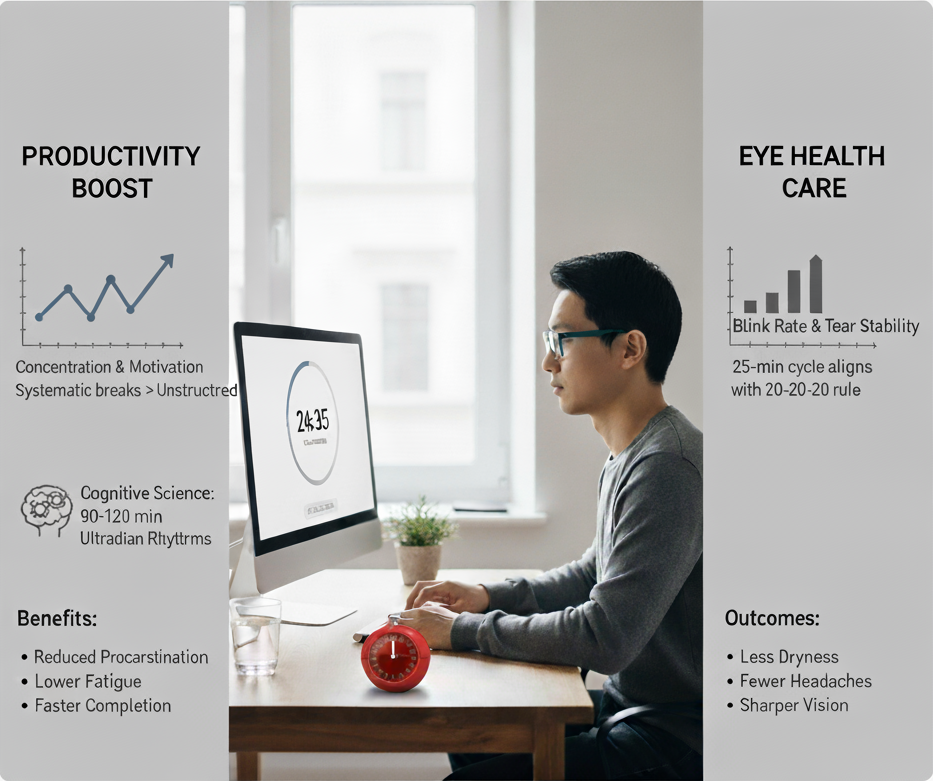
- •Reduced procrastination through breaking overwhelming tasks into manageable 25-minute segments
- •Average 25 minutes to refocus after interruptions (Dr. Gloria Mark, UC Irvine), making protected 25-minute intervals especially valuable
- •Higher productivity averages compared to unstructured approaches
Cognitive Science Backing
🧠Neurological Principles
Humans operate on 90-120 minute ultradian rhythms affecting peak focus. The 25-minute Pomodoro intervals align with natural cognitive cycles while preventing exhaustion of cognitive resources.
The technique leverages Parkinson's Law - "work expands to fill time available" - by creating time constraints that promote focused bursts and combat procrastination.
🎯Attention Span Research
Average human attention span for screen-based tasks has decreased from 2.5 minutes (2004) to 47 seconds (2024).
✓ However, sustained attention for focused work remains optimal at 20-45 minutes when breaks are incorporated. The Pomodoro's 25-minute structure falls perfectly within this evidence-based window.
💊Dopamine and Reward System
Regular breaks create periodic rewards after work intervals, triggering motivation through dopamine release in the brain's reward system. This neurochemical response helps maintain engagement throughout longer work sessions.
Eye Health Connection
👁️Perfect Structural Alignment
The Pomodoro Technique's 25-minute intervals closely match or exceed ophthalmologist recommendations for the 20-20-20 rule. This creates natural, built-in eye care without requiring separate tracking systems.
Clinical Evidence for Regular Breaks
A 2020 peer-reviewed study found educating Computer Vision Syndrome patients about regular breaks led to significant improvements in dry eye symptoms and tear film stability.
The American Academy of Ophthalmology identifies people spending 2+ continuous hours at screens as highest risk for digital eye strain - the Pomodoro's 2-hour checkpoint (4 pomodoros) for extended breaks aligns precisely with this clinical threshold.
Eye Strain Prevention Mechanisms
- ▸Accommodation Relief: During Pomodoro breaks, eye muscles relax from near-focus strain. Looking at distant objects provides the same physiological principle underlying the 20-20-20 rule.
- ▸Blink Rate Restoration: Screen users normally blink 15 times per minute, but this drops to 5-7 times during focused screen work - a 50-66% reduction. Break-taking encourages increased blinking frequency, reducing dry eye symptoms.
- ▸Tear Film Stability: Regular breaks prevent tear film instability and maintain healthy eye lubrication.
Digital Eye Strain Statistics
Adults with computer vision syndrome
DES prevalence during pandemic
Average daily screen time for Americans
Symptoms Addressed by Regular Breaks
Headaches
Reduced through break-based eye relaxation
Blurry vision
Prevented by allowing refocus time
Dry, irritated eyes
Improved through increased blinking
Neck/shoulder pain
Reduced by posture changes during breaks
Effectiveness Data
Task Completion Metrics from 2025 Study
• Average task completion: Pomodoro 69.41% vs self-regulated 70.32%
• Similar completion rates achieved in shorter total time for Pomodoro users
• Average productivity: 2.86 (4-point scale) with higher consistency throughout sessions
• Motivation levels: 2.73 (4-point scale) with steadier maintenance than irregular patterns
Focus Enhancement
- ✓Pomodoro users were more concentrated and motivated
- ✓Tasks perceived as less difficult when using structured break system
- ✓Reduced mind-wandering reported in multiple studies
- ✓Users complete similar work volumes in 20-30% less time due to efficiency gains
💡 Microsoft Research Findings:
Brain wave activity differs measurably when taking breaks - breaks don't just alleviate stress, they actively improve performance and prevent burnout by conserving mental energy for sustainable productivity.
Optimal Break Timing for Combined Benefits
Evidence-Based Protocol
Primary Cycle (25:5)
25-minute work intervals (exceeding 20-minute eye care recommendation) with 5-minute breaks (far exceeding 20-second minimum)
During 25-minute work period:
- • Maintain good posture
- • Blink consciously
During 5-minute breaks:
- • Look at distant objects
- • Walk away from screen entirely
- • Blink frequently
- • Avoid checking phones (creates continued near strain)
Extended Breaks (Every 2 Hours)
Every 4th break (after 2 hours total work), take 15-30 minute breaks away from all screens.
ℹ️ This matches the clinical risk threshold - 2-hour continuous screen use represents the point where eye strain risks significantly increase.
DeskTime Research Insight: While optimal work-break ratios may be 52 minutes work to 17 minutes break, Pomodoro's 25:5 ratio proves more practical while maintaining core benefits and stronger compliance.
Implementation for Eye Health
⚠️ For High-Risk Users (7+ hours daily screen time)
- ▸Consider shorter work intervals: 15-20 minutes instead of 25
- ▸Increase break frequency for more eye rests
- ▸Add humidifier to work environment (dry air exacerbates symptoms)
- ▸Schedule annual comprehensive eye exams
- ▸Consider computer glasses optimized for 20-26 inch viewing distance
Expected Outcomes
Reduced stress and anxiety
25-minute commitment feels achievable vs. indefinite work periods
Increased accomplishment
Each completed pomodoro provides sense of progress
Better time awareness
Physical timer creates calming structure once users adapt
Gamification effect
Tracking pomodoros adds playful, motivating element
Evidence Strength Summary
The Pomodoro Technique represents a dual-benefit approach - enhancing both cognitive performance and physical eye health through a single, simple framework that aligns with human neurobiology and ophthalmological best practices.
The Bottom Line
The Pomodoro Technique isn't just a productivity hack - it's evidence-based self-care.
Recent studies show that structured 25-minute focus intervals with 5-minute breaks not only boost concentration, motivation, and efficiency, but also protect your eyes from digital fatigue. Regular micro-breaks improve blinking, prevent dryness, and maintain tear-film stability - meaning clearer vision and steadier focus hour after hour.
With Vision Guard for macOS, you can make Pomodoro cycles effortless:
- ✓Automated 25:5 focus and rest sessions that sync with your workflow
- ✓Smart reminders that pause for calls or full-screen apps
- ✓Guided eye-relaxation visuals during every break
- ✓Progress tracking that turns small cycles into measurable improvement
Work in rhythm. Rest your eyes. Protect your focus.
Start your first smart Pomodoro today and feel the difference by evening.