The 20-20-20 Rule: Latest Research and Effectiveness
The 20-20-20 rule—looking 20 feet away for 20 seconds every 20 minutes—shows mixed scientific evidence despite widespread endorsement. Recent 2023-2025 peer-reviewed research reveals nuanced effectiveness.
Key Studies
Talens-Estarelles Study (2023)
Participants: 29 computer users over 2 weeks
Results: Significant improvements in dry eye symptoms (p ≤ 0.045) and accommodative facility (p = 0.010).
⚠️ Note: Improvements disappeared within one week of discontinuation. No changes in binocular vision parameters or objective dry eye signs.
Johnson & Rosenfield Study (2023)
Participants: 30 participants
Results: No significant differences in reading speed, accuracy, or DES symptoms across different break frequencies (p = 0.70).
⚠️ Conclusion: Insufficient evidence to support 20-second breaks as therapeutic intervention.
Thai Hospital Study (2024)
Participants: 27 staff members over 3 weeks
Results: Statistically significant decreases in digital eye strain (p < 0.05).
Alghamdi Study (2020)
Key Finding: Tear break-up time increased 38% from 6.20 to 8.55 seconds (p = 0.005)
Note: Overall CVS scores showed no significant change.
💡 Critical Context
Dr. Jeffrey Anshel, who created the rule in the late 1990s as part of his "3B approach" (Blink, Breathe, Break), acknowledges there is "no scientific backing for this specific guidance." The numbers were designed as a catchy mnemonic rather than evidence-based parameters.
Effectiveness Statistics
Users who regularly practice the rule
(Datta 2023, n=432)
Practice at least occasionally
(Regular + occasional users)
Digital device users experience eye strain
Population Impact
- •104 million working-age Americans spend 7+ hours daily on screens
- •97% of digital device users experience some form of digital eye strain
- •41% of teenagers engage in 8+ hours daily screen time
Outcome: Users following the rule showed significantly fewer burning sensations and headaches, though overall symptom scores remained comparable to non-practitioners.
Implementation Tips
Setting Up Effective Reminders
Desktop & Browser Tools:
- ▸Eye Saver (Chrome Extension) - Full browser overlays with customizable durations
- ▸20-20-20 Eye Protector (Microsoft Store) - Dark mode support
- ▸Twenty (Microsoft Store) - Emphasizing scientifically-proven methods
Mobile Solutions:
- ▸Eye Care 20 20 20 - Recommended by American Academy of Ophthalmology
- ▸Relax Eyes-Pro - Apple Watch support and Dynamic Island integration
- ▸Blinkzilla - Material 3 design for 2024
Common Implementation Mistakes
- 1.Not actually looking away - Staying focused on near objects during "break"
- 2.Taking less than 20 seconds - Experts suggest 30-60+ seconds may be better
- 3.Setting reminders but ignoring them - Compliance is the primary challenge
- 4.Relying solely on 20-20-20 - Without addressing ergonomics, lighting, or screen position
- 5.Poor ergonomic setup - Where breaks alone cannot compensate
Physiological Mechanisms
👁️How Distance Viewing Helps
The accommodation system experiences continuous stress during screen use. When viewing screens at typical 20-26 inch distances, ciliary muscles contract constantly to maintain focus. At 20 feet ("optical infinity"), light rays enter the eyes parallel, allowing complete muscular relaxation.
⚠️ Important: Research from Modern Optometry (2023) suggests 20 seconds may be insufficient - studies indicate 90+ seconds may be needed to return to baseline accommodative values.
💧Blink Rate Restoration
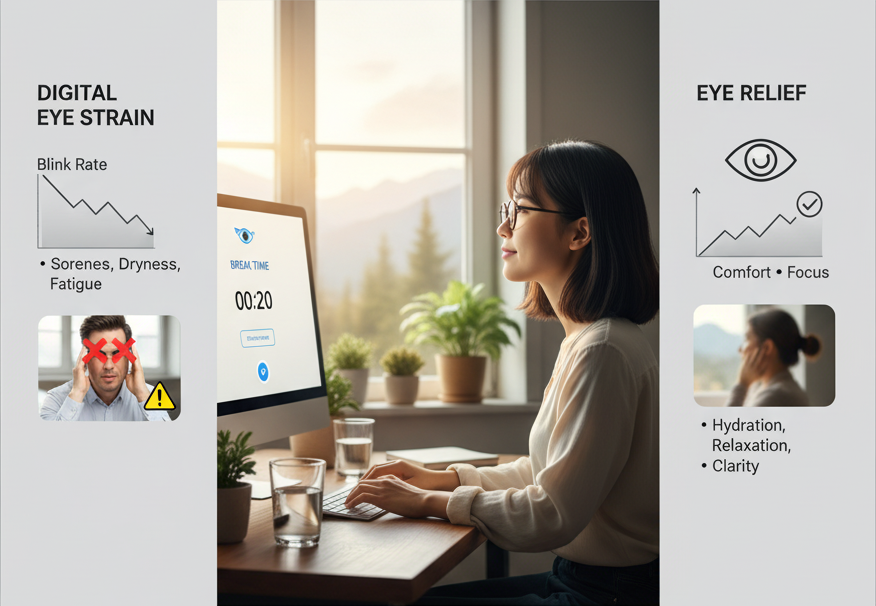
Normal blink rate is 15 times per minute, but drops to 5-7 times per minute during screen use - a 60% reduction.
During distance breaks, natural blink patterns resume, re-establishing tear film and lubricating the ocular surface.
🔄Convergence Relief
Near work requires extraocular muscles to keep eyes converged inward continuously. Distance viewing returns eyes to neutral alignment, relieving this convergence stress and reducing associated symptoms like eye pain, pressure, and heaviness.
Enhanced Recommendations
American Academy of Ophthalmology
Recommends combining the 20-20-20 rule with additional measures:
- ✓Sit 25 inches from the computer screen (arm's length)
- ✓Position screens so eyes gaze slightly downward
- ✓Blink consciously and frequently
- ✓Use artificial tears when eyes feel dry
- ✓Adjust brightness to match surrounding light levels
American Optometric Association
Suggests extended breaks:
- ✓15-minute breaks for every 2 hours of screen time
- ✓In addition to the 20-20-20 intervals
- ✓5+ minutes per hour of distance viewing for maximum benefit
📊 Evidence-Based Position
While the specific 20-20-20 parameters lack robust validation, the general principle of regular breaks with distance viewing shows consistent benefit for symptom relief, particularly for dry eye and headaches. Best practice involves using 20-20-20 as one component of comprehensive digital eye strain management rather than a standalone solution.
The Bottom Line
The 20-20-20 rule works - but only if you actually follow it.
Research between 2023 and 2025 shows that short distance-viewing breaks can reduce dryness, headaches, and visual fatigue - yet most users either forget or take breaks too short to help. The science is clear: your eyes need regular distance focus, blinking, and brief rest to stay healthy in a digital world.
That's where Vision Guard for macOS comes in.
It transforms good advice into a sustainable habit:
- ✓Automatic 20-20-20 reminders with clean, non-intrusive overlays
- ✓Guided eye exercises and blinking cues during breaks
- ✓Smart detection that pauses during meetings or full-screen apps
- ✓Progress insights that show how consistency improves your comfort
Don't just read about protecting your eyes - automate it.
Your 20-second breaks, done right.